Batteries and range
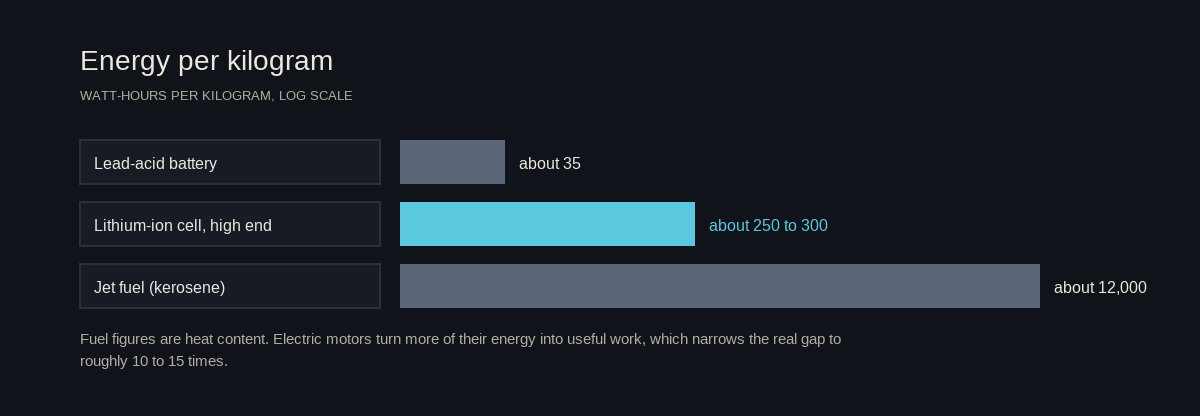
A kilogram of jet fuel holds about 40 times more energy than a kilogram of today’s best battery cells. Everything about air taxis follows from that.
The gap
Jet fuel stores about 43 megajoules per kilogram, roughly 12,000 watt-hours. High-end lithium-ion cells store about 250 to 300 watt-hours per kilogram. A finished battery pack, with casing, cooling and wiring, stores less than its cells.
Electric motors waste less of their energy than jet engines, which turn much of the fuel’s heat into hot exhaust. That narrows the gap to roughly 10 to 15 times in useful work. It is still a big gap.
What it means for design
Aircraft are sensitive to weight in a way cars are not. Every extra kilogram of battery needs more lift, which needs more power, which needs more battery. This is why eVTOLs are designed for trips of tens of kilometers, why they use wings for cruise, and why hovering is kept short. Hovering takes far more power than cruising on a wing.
Batteries also lose capacity with age and must keep a reserve for safety. The usable range is lower than the brochure figure.
What could change
Battery makers keep improving cells, with solid-state and lithium-metal designs aiming for 400 watt-hours per kilogram or more. Hybrid designs, which carry a small fuel-burning generator, trade some of the clean-air benefit for range. Hydrogen fuel cells are another path.
The energy question links to our sister site Type 2 Civilization, which covers how civilizations grow by capturing more energy.
Common questions
Why not just add more batteries?
More batteries add weight, and the extra weight needs more energy to lift. Past a point, adding batteries gives almost no more range.
How long does charging take?
Makers aim for fast charging between short flights, in tens of minutes. Real figures depend on the aircraft and charger.