What is an eVTOL?
Take a helicopter, swap the engine for batteries, and split the rotor into many small props. That is the basic idea.
The idea
An eVTOL takes off and lands straight up, like a helicopter, using electric motors powered by batteries. Most designs then fly forward on a wing, like a small airplane, which uses far less energy than hovering. The goal is short trips of a few dozen kilometers, such as from an airport to a city center, with less noise and no tailpipe.
Three layouts
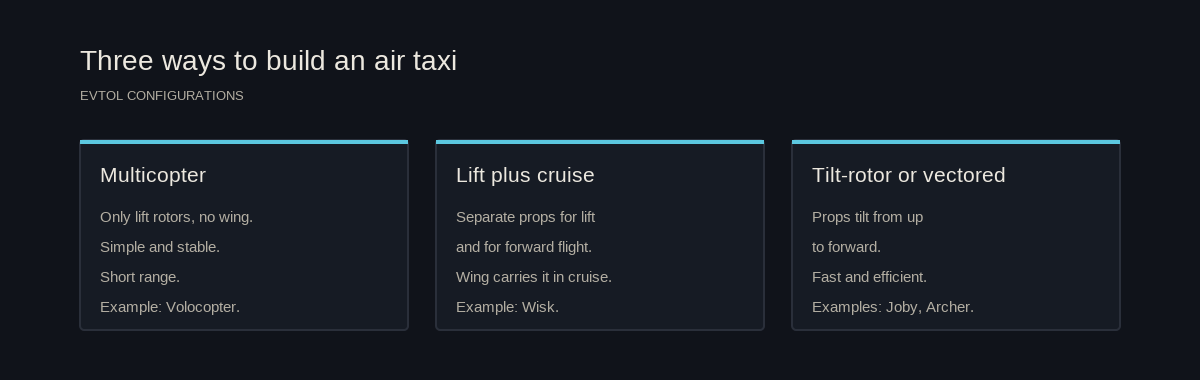
Multicopters, such as Volocopter’s designs, look like large drones, with many rotors and no wing. They are simple but have short range. Lift-plus-cruise designs, such as Wisk’s, use one set of props to lift and a separate prop to push forward on a wing.
Tilt-rotor or vectored-thrust designs swing their props from pointing up to pointing forward. Joby’s aircraft uses six tilting props. Archer’s Midnight has twelve, six that tilt and six that stay fixed for lift. These are faster and more efficient, but the transition from hover to cruise is harder to engineer.
Why many motors
Electric motors are small, light and simple, so designers can spread them across the aircraft. This is called distributed electric propulsion. If one motor or prop fails, the others can make up for it, which is a different safety picture from a helicopter with one main rotor.
The catch is energy. Batteries hold much less energy per kilogram than fuel, as our guide on batteries and range explains.
Common questions
Is an eVTOL a flying car?
Not really. Most cannot drive on roads. They are small electric aircraft built for short hops.
Are any carrying passengers in the U.S.?
Check the FAA and the companies for current status. Makers have been flight testing for years, and certification was ongoing in 2026.