The rules for air taxis
Building an aircraft is hard. Proving to regulators that it is safe enough for paying passengers is harder.
Certificates, plural
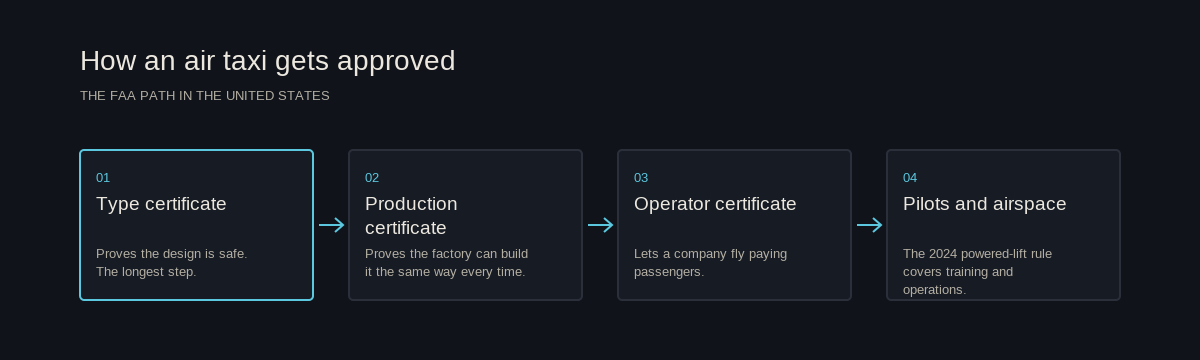
In the United States a new passenger aircraft needs three main approvals. A type certificate shows the design meets safety standards. A production certificate shows the factory can build each one to that design. An operator certificate lets an airline or air-taxi company fly paying passengers. Each takes years of testing and paperwork.
A new kind of aircraft
Many eVTOLs lift like helicopters and cruise like airplanes, which did not fit the existing rules. The FAA calls them powered-lift aircraft. On October 22, 2024, it issued a final rule covering how pilots of these aircraft are trained and certified and how the aircraft are operated. The FAA described it as the first new category of civil aircraft since helicopters in the 1940s.
The rule settled how a pilot can qualify, including on aircraft with a single set of controls, and set operating rules such as minimum altitudes and weather limits.
Where things stand
Joby and Archer have been working through FAA type certification for years, flying test aircraft and building factories. Both have also announced plans with partners outside the United States, including in the United Arab Emirates. Some well-known projects did not survive. Lilium, a German company that once announced a vertiport hub at Lake Nona in Orlando, ran out of money in 2025.
For updates, the FAA’s air taxi pages are the source to trust over press releases.
Common questions
Will air taxis fly without pilots?
The first services are planned with pilots. Self-flying passenger aircraft need further rules and testing.
Who controls the airspace?
The FAA. Early air-taxi routes are expected to use existing helicopter routes and procedures near cities.